Tag: History

  • Let’s take a ride down memory blvd: Kendrick Lamar’s Squabble Up

    Let’s take a ride down memory blvd: Kendrick Lamar’s Squabble Up

    Art by Author

    The excitement I felt when I heard the Debbie Deb sample on Kendrick Lamar’s Squabble Up off his new GNX project was overwhelming. It took me right back to being 12 and starting to navigate the treacherous teenage years with the help of music. The first record I remember buying was Fascinated by Company B. I listened to that song over and over and over again. This style of music that was called Freestyle was extremely popular and overlapped with a lot of early hip-hop in those days in California. According to Wikipedia, freestyle music developed in the early 1980s in New York:

    “It initially was a fusion of synthetic instrumentation and syncopated percussion of 1980s electro, as favored by fans of breakdancing. Sampling, as found in synth-pop music and hip-hop, was incorporated. Key influences include Afrika Bambaataa & Soul Sonic Force‘s “Planet Rock” (1982) and Shannon‘s “Let the Music Play” (1983), the latter was a top-ten Billboard Hot 100 hit.”

    I remember my first after school dance in the school gym at Raney Junior High in Corona in 1985. I walked into the school gym and the song “La Dream Team Is In The House” was playing and at that moment the most popular, pretty, and feared girl in school walked in with a level of confidence that I will never forget. She wore thick black eyeliner and a long flowy skirt and tank top. Her bangs were hair sprayed high and the sides of her hair were teased to look like wings, also shellacked with aqua-net. She was walking into the dance while that song was playing and she sang along to the chorus but changed the words to hype herself. “oh yes we’re here, the dream team is here” became “oh yes I’m here, Alice is here.”

    Other notable songs that I loved from that genre and time that really exemplified the era include the following, and in certain neighborhood swap meets or backyard parties all across the Southland, these songs still get regular rotation:

    I created the main collage art and included it as a free hi-res digital download where you can access it here. (Copyright Sylvia Marina Martinez, 2024. Not for resale, personal use only). If you would like to make a donation to support my work including all my free content on my two main blogs, I very much appreciate it.

  • Harmonies and healing Frequencies: Musician Cinamon Blair carries On the musical legacy of her grandfather, left-handed Banjo & Guitar jazz musician Lee Blair

    Harmonies and healing Frequencies: Musician Cinamon Blair carries On the musical legacy of her grandfather, left-handed Banjo & Guitar jazz musician Lee Blair

    As I was recovering from the flu last week I decided to watch the documentary American Symphony on Netflix and it was absolutely heart-wrenching and timely and spoke to the incredible creativity required to survive a history as brutal and violent as American history. The story really reminded me of the healing and survival power of creative expression, especially music. Multi-instrumentalist musician and music therapist Cinamon Blair life story and family legacy is one thread of that historical tapestry that needs to be shared.

    Of Cherokee, Choctaw, and Chickahominy lineage, her roots are in the Southeast US. Her musical legacy most recently goes back to her paternal grandfather. He was jazz musician Lee Blair, who migrated from Savannah, Georgia to Brooklyn in the 1920s and played and recording with Jelly Roll Morton’s Red-Hot Peppers, Louis Armstrong, Luis Russell, Billy Kato, Thomas Morris’s Seven Hot Babies, and Charlie Skeete. It was from this rich musical legacy that Cinamon was born into. Brooklyn-born, Massachusetts-based Cinamon is currently playing with the bands Rebirth and Brown Bones as well as continuing to work on her own music.

    ~ Cinamon Blair

    Here is my interview with the effervescent Cinamon Blair.

    What styles of music growing up sparked your love of music?

    Can you tell me about your interest in music therapy and in what ways do you use musical therapy for yourself and how do you work with it for others or in what ways have you seen music be a healing force in your life?

    Are there any non-musical influences that inspire your creativity?

    What advice would you give to emerging artists who are just starting their artistic journeys?

    Can you describe the role that community and cultural heritage play in your work?

    Are there any particular influences or sources of inspiration that have shaped your artistic practice?

    Could you share a specific project or artwork that holds significant meaning to you? What was the inspiration behind it?

    How do you see your art contributing to or engaging with broader social or cultural conversations?

    Anything else you would like our readers to know about you or your art?

    Thank you to Rebirth’s Conga player I-shea Iréne Shaikly for putting together this playlist. Follow her at @ishea_music.
    Playing and harmonizing with Brown Bones.

    CHECK OUT CINAMON’S PROJECTS

    CINAMON’S RECOMMENDED ARTISTS:

    Grandfather, Lee Blair, II and Father, Lee Blair, III (on the right holding the guitar neck) and uncle, Julian Blair 
  • The Cosmic Heart of Fiddler Anne Harris

    The Cosmic Heart of Fiddler Anne Harris

    “I started begging for a violin when I was three and my mother took me to go see the movie version of ‘Fiddler on the Roof’. She tells me that I stood up out of my seat in the beginning of the film when Isaac Stern is shown in silhouette playing the overture, pointed to the screen, and shouted, “Mommy that’s what I want to do!”

    “I grew up in a house filled with music, within a community filled with music, within a music-filled world. My dad was an avid vinyl collector, and both of my parents loved music of all genres. Those sounds were the sonic backdrop of my childhood. Blues, Gospel, Classical, Opera, Musical Theater, Folk, Pop, Jazz, Soul, Country, Rock, and much more. The radio, my older sister’s collection, my friend’s music… All of it was foundational to my musical development. And being immersed in such a wide variety of music was a gift for which I’m so deeply grateful. The things that really spoke to me came from different parts of who I was exploring as I grew. I loved Issac Stern because he worked impossible magic with his instrument. I loved Stevie Wonder because of his obvious genius- weaving those incredible tapestries of emotion, with sound, with story. Mahalia Jackson because her voice was a direct conduit to Spirit. I loved the Musical ‘Hair’ for its freedom, (I performed in an amazing version of it produced entirely by me and my friends!), and Musical Theater in general. I loved to dance so Prince, Parliament Funkadelic, Rick James…and many many more of course. But honestly, I never thought specifically about becoming a professional violin player, because although I was in love with the instrument, I was trained Classically, and I never saw myself adhering to that structure. I really loved the freedom that improvisational players had, like guitar players, and since I wasn’t really listening to Bluegrass or Old Time music, it simply never occurred to me that I could take my instrument into contemporary genres. If you don’t SEE it, oftentimes it is really hard to imagine it when you are young. Because most young people begin their musical explorations by imitating what they see that excites them. I never saw a Black person playing Blues or American Roots music growing up, and certainly never a woman.”

    “These groundbreaking artists encapsulated for me what was possible for the instrument beyond the world of Classical music, or really even beyond Jazz as I was starting to play out in American Roots bands  and Rock bands in Chicago. But as far as Jazz players, Regina Carter really snapped my neck as well. Her versatility and soul are astounding.”

    Playlist of Anne’s Music as well as a few of her inspirations mentioned above.

    Photo by: Laura Carbone
Collage by: Sylvia Marina Martinez
    Photo by: Laura Carbone
    Collage by: Sylvia Marina Martinez
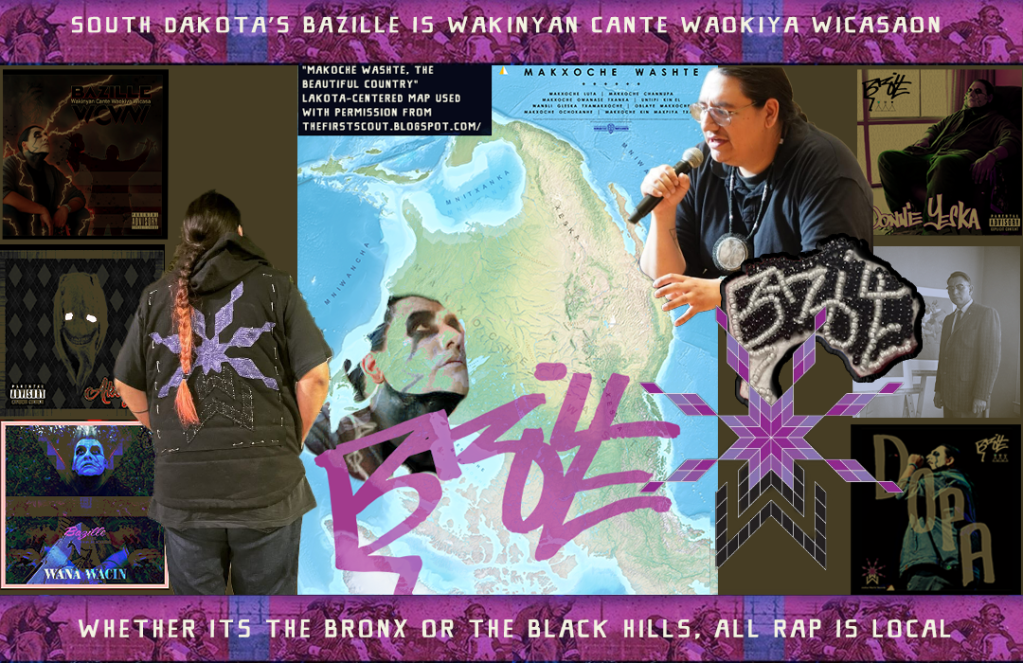
  • South Dakota’s Bazille is Wakinyan Cante Waokiya Wicasaon

    South Dakota’s Bazille is Wakinyan Cante Waokiya Wicasaon

    Whether its the Bronx or the Black Hills, All Rap is Local

    Attributions
    • All photos and graphic elements featured in collages copyright of Bazille, used with permission.
    • All collages and writing by Sylvia Marina Martinez
    • Map in featured collage created by thefirstscout.blogspot.com and used with permission

    I’ve always thought of rap as a form of folk music or street journalism such that it is a localized art form that springs forth from a specific community to define a specific time and place and the lyricist, a poetic scribe, shares their personal truth as well as describing the communities and lived realities of the communities they come from. Those who speak truth from the heart will inevitably resonate beyond the neighborhoods they represent. Hip-hop has given a voice to folks whose stories have often fallen between the cracks of the mainstream narratives in the media landscape. Rapper/producer/sound designer Bazille of the Cheyenne River Lakota and Crow Creek Dakota tribes is a multi-talented artist who has a gift for narrating his experience in illustrative detail, as an songwriter, lyricist and a producer. Bazille takes his listeners on a sonic trip to see through his eyes his current and ancestral homeland which is the area known as the United States. No culture or community is a monolith and thus as with other subcultures in America, there is no one Native American experience or story, but as many stories as there are people, and all of those stories deserve to be heard.

    Earlier this year, I made a video edit and blog post about mural graffiti artist and community organizer, Derek “Focus” Smith. In the course of compiling that video, I asked Focus for an artist who he might want to feature in the background music of the video. He recommended Bazille so I reached out to him and let him know what I was working on and he generously sent me files and files of instrumental tracks to choose from. As I started listening to Bazille’s many many tracks and following him on social media, I was overwhelmed by his prolific talent. I highly recommend listening to all his music.

    I’ve been streaming his album, WCWW (Wakinyan Cante Waokiya Wicasa) on repeat. He creates a distinct atmosphere and feeling with each track such that each song stands on its own,  yet as an album it is a cohesive story.  He is  steadily and continuously putting out his own music and producing music for other artists as well as creating soundscapes for various plays and art exhibitions.  Since I did the interview with him back in July, he’s already released his younger brother’s posthumous album, Akoyeh as well as this Sound Art Album as part of an exhibition honoring Dakota Artist and Cultural Icon Oscar Howe

    Though he had no access to musical education or instruments growing up very poor in a rural town far from any city, he did grow up in the internet era and was able to get free versions of all kinds of musical production software. We spoke about how he got started in music and the artists and albums who inspired him to rap, especially Maniac (the Siouxpernatural) and Derelict.

    Maniac lived on the same reservation and gave him his first mic. Bazille still lists Maniac’s album“Nightmerika” as one of his favorite albums.

    “Maniac’s (music) sounded like Eagle Butte and a particularly dark time and side of Eagle Butte. There’s always something you hear in the vibe and energy that is specific to that location.”

    Music can be so many things to humans because it’s so powerful it can be a mirror to help us give voice to emotions we previously couldn’t put words to or it helps us dream of possibilities beyond our current circumstances. For young teens, but I think for a person of any age, hearing music that resonates with your own experience or speaks to a particular time and place can really help a person feel seen and heard.

    Bazille’s music is also  a vehicle for community empowerment and education in that he shares a lot of knowledge and experience  in his songs but also through his work at the Wonahun Was’te’ Studios, As part of a community arts center, anyone can have access to the studio label’s network, entry-level equipment and software, tutorials, guidance on using  software and equipment, and support through the production and release process. Through his assistance, Bazille is able to give kids today access that he didn’t have growing up. 

    In terms of producing and collaborating with other artists, Bazille said

    “My thing is conceptualizing and obsessing over themes and storytelling. So finding a way to naturally [add my contribution] like whatever songs we’re creating out of our time together, whether it’s online or in person.  I think that’d be disrespectful to not put forth full energy and effort. I make sure that my 50% is [solid] It’s like, it comes together in a way that, like my input can be okay, here’s how it’s structured. Or here’s a couple of beats from me, or a couple of features from people that I know, that maybe you haven’t worked with yet. And vice versa.” 

    Regarding him speaking out on topics that he feels strongly about.

    “I overheard an interview with a rap artist who was a freestyler. And he was really good at it. And he was saying, if you don’t have anything to say, then rap isn’t for you. And I was like Whoa, taken aback by that, like what does he mean? And so then moving forward, I became obsessed with that. So certain things I would listen to would either be because of that meaning or there’s also a production side of me that really appreciates the storytelling of sound, particularly King Crimson’s first album, the court of the Crimson King. It’s so well composed and put together.”

    Bazille has a series of solo singles reflecting on some salient topics both personal and political, but of course the personal is political. Bazille uses his music to show support for people in his community fighting for civil and land right issues as well as to make commentary on social issues both personal, and historical.

    One of his songs that really speaks to the nuances of contemporary effects of colonization is the song Land Acknowledgement. Specifically referencing the Sturgis Motorcycle Rally, which is in earshot of the mountain where local tribes traditionally pray and meditate. Bazille puts it this way:

    “Imagine, you’re in church and literally now or there’s people in the basement [being loud and disrespectful]. And you know, and you can see it all. [There is this] systematic thing that allows [kidnapping and drug] crime syndicates to thrive and so even though I’m a kind of anti-government or police type of dude, I would even say, if their job (the police) is to serve and protect, why promote the certain events and exchanges that definitely bring a rise in this activity? And then at the same time, they over-police our expression and our way of being since the moment they got over here.”

    We also talked about some future projects he would like to explore in depth.

    “One future project I want to do is to look at how different [indigenous] communities express hip hop, particularly in South Dakota. I’ve been in so many of them that I’d like to celebrate the history of it, but also looking at music history and American Indian relations history since the early times.”

    Referencing the documentary called Rumble: The Indians Who Rocked The World, featuring rock icons like Ozzy and Slash talking about Native American contribution to modern American music.

    “They basically got a lot of their stuff [archetypes/iconography] from indigenous people and characters in music history. And in many different tribes, I know this is true, but specifically in the one that I can speak for, which is my own, historically, we had people who the way that they describe it is, they would almost perform in a way that was happy and sad, made you laugh and made you cry. But that [character] also was the only thing out there that had the authority to, in a jester-like way, poke fun at leadership, question the everyday things that we just kind of follow and abide by. And I feel like in hip hop and rap, for those who are really like, passionate about the specific craft of it, they are particularly interested in doing just that. Questioning the authority, making fun of the authority, even though there’s a lot of fear in rap and hip hop. And then also making you scared, you know, with the visual, with the energy, with the sound, if you’re not ready for it, but then with that same energy almost making you proud and happy to the point where you would shed a tear. And you’ve got to wonder what it does for people to at least acknowledge the reality, good or bad, that exists there in somebody’s psyche. Because, you know, in these, if you talk to any of these artists, none of these artists is about self harm, or community self harm. I refuse to believe that I think some are oblivious to the effects that some of these things can have. But there are artists out there who kind of dance this dangerous line. And, and I feel like it’s for a really just purpose that people don’t often understand. But I think that’s part of the dance, the ancient dance of the jester, which is to be misunderstood. They say good comedy, right half of the room is laughing. Half of the room is disgusted and horrified. And I feel like in rap, that’s often the case.”

    We talked about how the legendary Tupac played that role in mainstream hip hop and the significance of artists who bring their genuine, vulnerable selves to their work. Referencing DMX during Woodstock 99:

    “I think of the sacrifice that DMX made as a human being, as a spirit, to bring that kind of genuine prayerful energy to any space he walks into, regardless of who’s there. And I feel like that’s a real reason why something like that is so impactful, too, because, you know, we share these things with intention, and with vulnerability and prayer. But I think what gets lost in the capturing of those moments is oftentimes, those have to be in situations in places where you are under-appreciated for doing so. [But in most of those type instances,] I feel like we as the public won’t see them. Because when they’re done out of that genuineness, you know, they’re not announced. It’s not a big deal. It’s just like, when we go on to a ceremony as Dakotas or Lakotas, a lot of my uncles will say, ‘we’re not here for a spectacle for a show.’ We’re just here to devote ourselves in prayer to say thank you, to hope that we are making ourselves strong for whatever future may come to accept good or to accept bad that comes our way and make the best of it when we can. But when we go into that space of prayer, we aren’t expecting a million light shows and God to come and say everything’s gonna be okay. It’s part of that faith is not knowing.”

    We spoke a bit about his late younger brother Taran and how he (Taran) was able to take his adversity and rather than become bitter, he grew in his understanding of the universe, his spirituality and faith.

    “When I came back from college I was really worried because I only visited home three times in those four years. When I come back and we’re getting older and he’s getting a job and doing this and that if he ever has any extra, he was helping people. He wasn’t announcing it to the world.”

    In terms of his brother Taran’s music,

    “He grew up seeing me do it my whole his whole life. So, you know, when he passed, I actually went through his files and I knew that we had recorded maybe two or three things together. .. But when I started searching back in the logs of his folder he had made like three other songs. And I never heard them before until after he passed. So that was a trip. And since then, I’ve been finishing them and and like mixing and mastering them, to put an album out for him (Akoyeh, released in July 2023). ”

    Below are links to interview clips Bazille has recently posted on his instagram as well as links to the various exhibits and plays he has done the sound for. Follow Bazille on Instagram and Bandcamp to keep up with his latest creative endeavors.

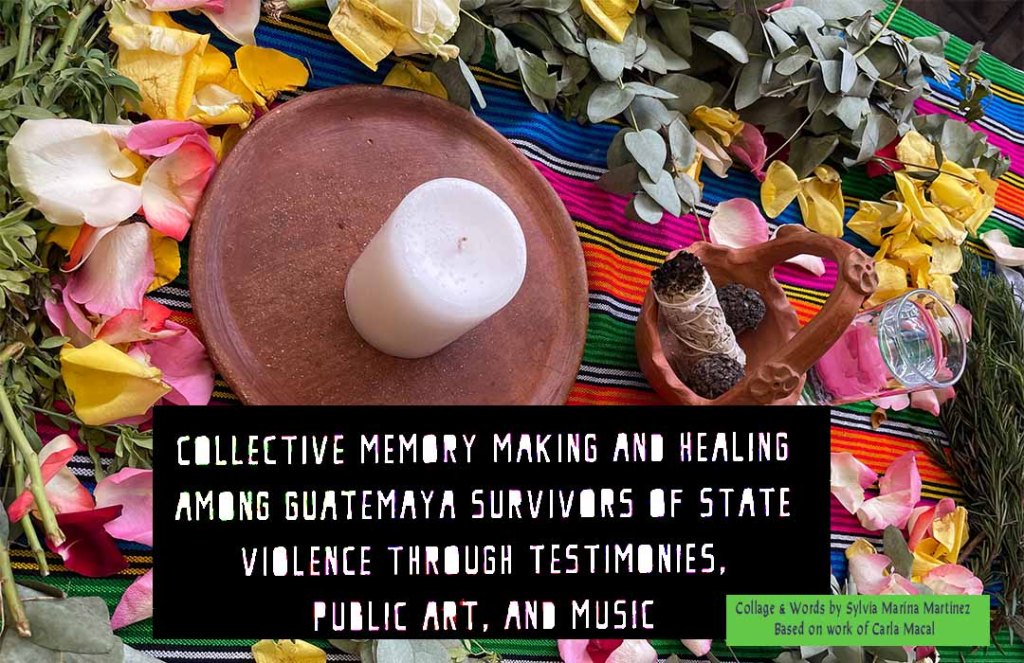
  • Collective memory making and healing among GuateMayan survivors of state inflicted violence through embodied testimonies, public art, and music.

    Collective memory making and healing among GuateMayan survivors of state inflicted violence through embodied testimonies, public art, and music.

    Video about Carla’s dissertation.
    GuateMayan musician Aurora Nohemi sings about women uniting and culture.

    GuateMayan Rebeca Lane – La Cumbia de la Memoria sings about the reality of genocide

    Resources and articles below so anyone may educate themselves on the realities of Indigenous Guatemala.

  • Multi-instrumentalist and Grammy-winning songwriter Dom Flemons  illuminates hidden American history in his music.

    Multi-instrumentalist and Grammy-winning songwriter Dom Flemons illuminates hidden American history in his music.

     "...this album is quite a departure for me because I decided not to present a historical concept record like my previous Smithsonian Folkways album, Dom Flemons Presents Black Cowboys (2018). Instead, I spent a lot of time combing through my record collection and personal archives to gather inspiration for the 15 songs on the album. Ever since I started performing professionally in 2005, I've mainly focused on presenting the lesser-known songs and stories of tradition-bearers who are at the foundation of American roots music. I've done this while playing an array of musical styles and vintage instruments rooted in tradition. This time around, I wanted to shift gears and bring my original songs into focus by highlighting stories written with my own pen. "
    "I wrote the title track, "Traveling Wildfire," right around my birthday on August 30, 2021, while my family and I sat in a hotel room in Nashville being bombarded by Hurricane Ida. As we waited out the storm and watched simultaneous reports of flooding in New Orleans and massive wildfires in California, I began to write about the fragile uncertainty of living through the pandemic and the looming dangers of traveling down the road. With this cinematic audio experience describing the scene in front of me, I implore the listener to let the restless beat of the marching bass drum lead you into the depths of the quiet floating atmosphere of ''Traveling Wildfire.'"
    "The second western song is "Saddle It Around," which comes from the repertoire of the legendary gospel songster Reverend Gary Davis. I first heard "Saddle It Around" when a friend contacted me to discuss on his radio program the history of the Black West. Afterwards, he provided me with a curated playlist of western songs that included a recording of "Saddle It Around" from the album, At Home and Church, 1962-1967, released in 2010 by Stefan Grossman's Guitar Workshop. The song first struck me because I found the picking pattern to be very different from any other Rev. Davis song I had ever heard. The fragmentary story also intrigued me: the journey of a Black cowboy traveling down the road only to be arrested for no crime, and for no reason at all for that matter."
  • Beats, rhymes, & life along the journey… & goodbye to Facundo Cabral

    My good friend DJ Moonbaby was spinning some gems tonight and she inspired me to write a blog post and share some of the musical wealth with you. Some beats, rhymes and life to help push us through as we walk along this sometimes bumpy and unexpected road…Speaking of journeymen, I have to acknowledge the passing of Argentine folk singer and peace activist Facundo Cabral, who was murdered in Guatemala today in an ambush style attack – truly horrific. As a 9 year old child, he once walked 1800 miles to look for work to support his mother and six siblings after his father abandoned them. He literally grew up dirt poor, illiterate, and went to on to teach himself to read, to learn, and his consciousness was raised and he went on to become one of the most beloved folk singers in Latin America. In the year 2011, a killing like this reminds us that oppression and fear still are alive and well and we must continue to rise up together as a human family and do what we can to bring peace and justice to the world. At the end of the post you can see his signature song from a performance, which I believe is from the 1970s.

    Back to the music at hand. From the Moonbaby playlist here is Tribe Called Quest with the song “Electric Relaxation” from the album Midnight Marauders from the year 1993. Sheer perfection:

    That jogged my memory of this 1995 classic from the LA group, Pharcyde, “Runnin”, featuring sample from Brazilian samba:

    Another Moonbaby tune. Talib Kweli featuring Norah Jones with the gorgeous “Soon The New Day”:

    This song ties it all together for me, “History” by Mos Def featuring Talib Kweli:

    If we don’t understand the past and where we came from we are doomed to repeat….Here is Facundo Cabral with a hauntingly profound performance of “Yo No Soy De Aqui Ni Soy De Alla.” May he continue his journey with our ancestors and find peace on the other side:

    “Our lives begin to end the day we become silent about things that matter.”
    ~Martin Luther King Jr.

    Related Posts:
    La poesía, nueva canción, y trovadores

    From DC to Digable Planets to DJ LadybugMek

    Bringing the (City of) Angels back to higher ground: DJ Moonbaby

    Meandering through the homeland of Los Angeles: DJ Moonbaby, Canter’s Deli, Lalo Guerrero, & Petrovic Blasting Company