

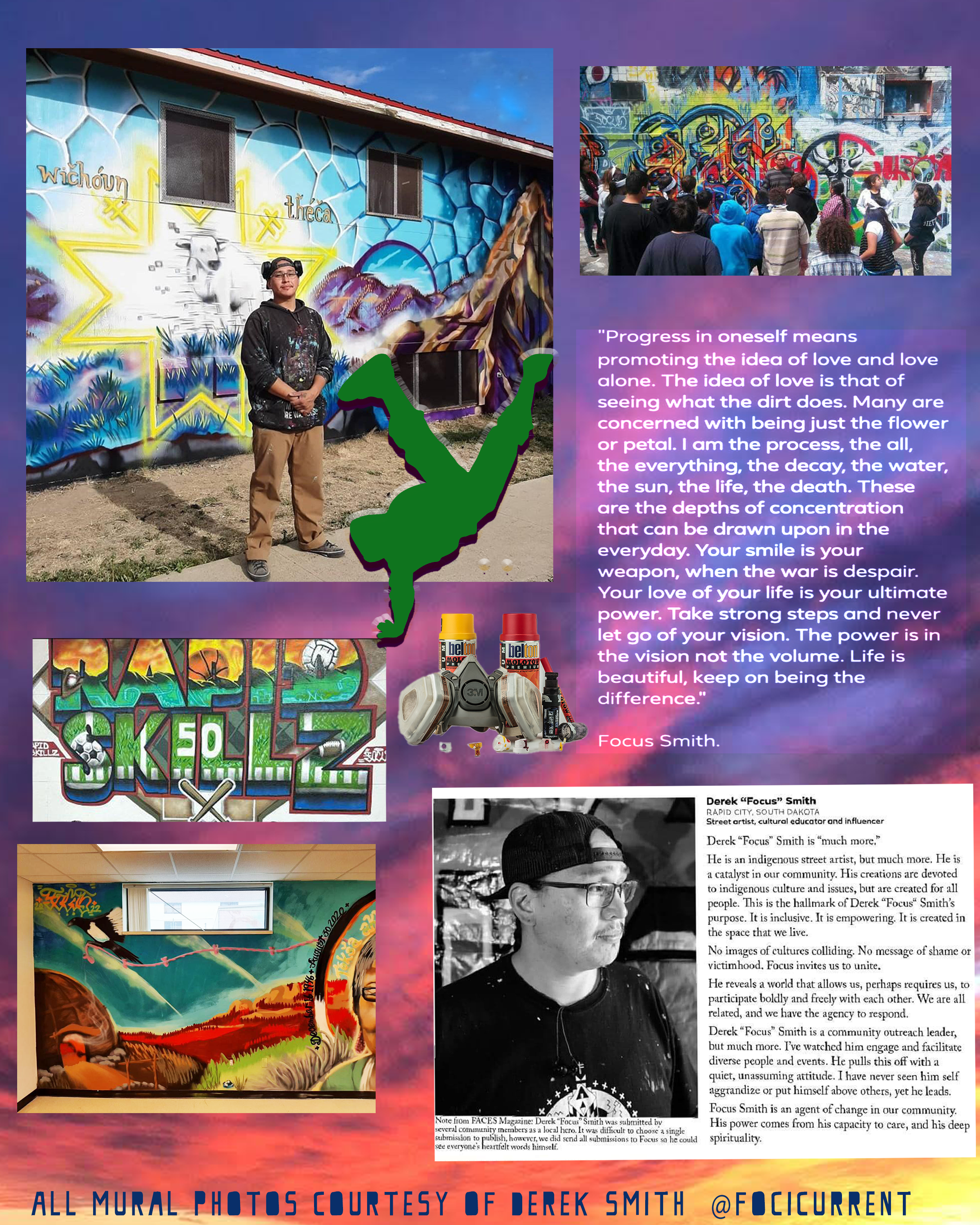
Lakota graffiti artist, muralist and community organizer Derek “Focus” Smith has been challenging the power structure of the “Mississippi of the North” since the early 2000s bringing the power of graffiti and muralism to the Reservation and using his craft to tell the stories of Lakota history and encourage the youth. The art has taken him around the world. I first ran across Focus’ work during the uprisings after the death of George Floyd on Instagram and saw he had contributed a mural in the George Floyd Memorial. As a collage artist, I’m extremely influenced by all forms of political and cultural street art so Focus’ story was extremely compelling and the more I learned the more inspiration I drew from his work. This video below I made using the footage from the talk he gave to the Racing Magpie organization in South Dakota.
The music I used in the video is all by Talon Bazille, a rap artist, producer and sound designer from the Cheyenne River Lakota and Crow Creek Dakota tribes in South Dakota. As a college student at the University of Pennsylvania, Bazille hosted a weekly radio show in an effort to promote underground hip hop artists. As a result, he took the plunge back into creating his own music, which he had begun recording at age 13, under the wing of supportive uncles in South Dakota, producing beats and learning how to engineer audio in the process. Upon graduating with a bachelor’s degree in psychology, Bazille released what he considers his “personal thesis” project: “Sake” (Talon in Dakota), a 51-track self-produced solo album.Today, Bazille lives in South Dakota where he continues to create music, produce other artists, and compose soundscapes. His work has been performed in places like the Kennedy Center all the way to small tribal halls back on the reservation. Here is his latest video:
As hip hop culture celebrates 50 years, its reach and influence has encouraged legions of youth from around the globe to give voice to their struggles to tell their stories through the rhymes, beats, and words both creating a visual and sonic movement. The attempt to erase Indigenous history and culture is well-known in the abusive paradigm of settler colonialism that is still attempting to silence and erase the reality of the brutality and hide the hypocrisy in the American story. I see hip hop music (and culture) as the ultimate roots music that has emerged as a form of street journalism narrating the stories of the voiceless. As long as humans have existed, folks have expressed resistance and resilience to oppression through art and music. As many who are paying attention to the current politics the authoritarian extremists are fighting hard to hold onto the last vestiges of a crumbling empire. Any of us alive today regardless of where we live need to realize that “none of us are free until all of us are free.” So many indigenous artists and activists are making their voice heard as poet Joy Harjo writes: “We are still America. We know the rumors of our demise. We spit them out. They die soon.”


Leave a Reply to Collective memory making and healing among GuateMayan survivors of state inflicted violence through embodied testimonies, public art, and music. – ROOTNOTEMUSIC BLOGCancel reply