Tag: Bazille

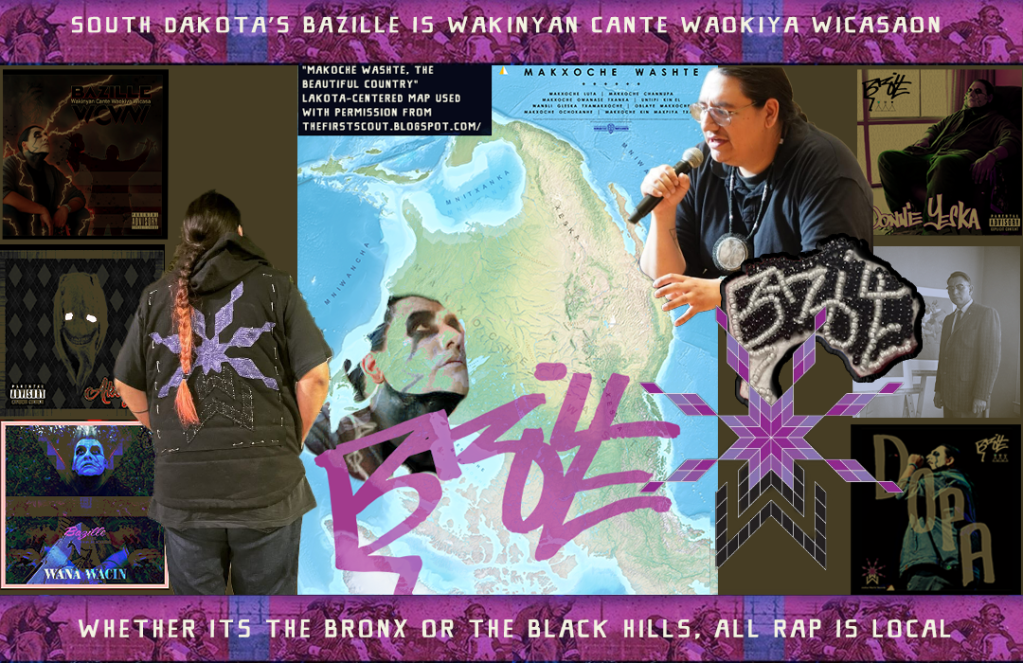
  • South Dakota’s Bazille is Wakinyan Cante Waokiya Wicasaon

    South Dakota’s Bazille is Wakinyan Cante Waokiya Wicasaon

    Whether its the Bronx or the Black Hills, All Rap is Local

    Attributions
    • All photos and graphic elements featured in collages copyright of Bazille, used with permission.
    • All collages and writing by Sylvia Marina Martinez
    • Map in featured collage created by thefirstscout.blogspot.com and used with permission

    I’ve always thought of rap as a form of folk music or street journalism such that it is a localized art form that springs forth from a specific community to define a specific time and place and the lyricist, a poetic scribe, shares their personal truth as well as describing the communities and lived realities of the communities they come from. Those who speak truth from the heart will inevitably resonate beyond the neighborhoods they represent. Hip-hop has given a voice to folks whose stories have often fallen between the cracks of the mainstream narratives in the media landscape. Rapper/producer/sound designer Bazille of the Cheyenne River Lakota and Crow Creek Dakota tribes is a multi-talented artist who has a gift for narrating his experience in illustrative detail, as an songwriter, lyricist and a producer. Bazille takes his listeners on a sonic trip to see through his eyes his current and ancestral homeland which is the area known as the United States. No culture or community is a monolith and thus as with other subcultures in America, there is no one Native American experience or story, but as many stories as there are people, and all of those stories deserve to be heard.

    Earlier this year, I made a video edit and blog post about mural graffiti artist and community organizer, Derek “Focus” Smith. In the course of compiling that video, I asked Focus for an artist who he might want to feature in the background music of the video. He recommended Bazille so I reached out to him and let him know what I was working on and he generously sent me files and files of instrumental tracks to choose from. As I started listening to Bazille’s many many tracks and following him on social media, I was overwhelmed by his prolific talent. I highly recommend listening to all his music.

    I’ve been streaming his album, WCWW (Wakinyan Cante Waokiya Wicasa) on repeat. He creates a distinct atmosphere and feeling with each track such that each song stands on its own,  yet as an album it is a cohesive story.  He is  steadily and continuously putting out his own music and producing music for other artists as well as creating soundscapes for various plays and art exhibitions.  Since I did the interview with him back in July, he’s already released his younger brother’s posthumous album, Akoyeh as well as this Sound Art Album as part of an exhibition honoring Dakota Artist and Cultural Icon Oscar Howe

    Though he had no access to musical education or instruments growing up very poor in a rural town far from any city, he did grow up in the internet era and was able to get free versions of all kinds of musical production software. We spoke about how he got started in music and the artists and albums who inspired him to rap, especially Maniac (the Siouxpernatural) and Derelict.

    Maniac lived on the same reservation and gave him his first mic. Bazille still lists Maniac’s album“Nightmerika” as one of his favorite albums.

    “Maniac’s (music) sounded like Eagle Butte and a particularly dark time and side of Eagle Butte. There’s always something you hear in the vibe and energy that is specific to that location.”

    Music can be so many things to humans because it’s so powerful it can be a mirror to help us give voice to emotions we previously couldn’t put words to or it helps us dream of possibilities beyond our current circumstances. For young teens, but I think for a person of any age, hearing music that resonates with your own experience or speaks to a particular time and place can really help a person feel seen and heard.

    Bazille’s music is also  a vehicle for community empowerment and education in that he shares a lot of knowledge and experience  in his songs but also through his work at the Wonahun Was’te’ Studios, As part of a community arts center, anyone can have access to the studio label’s network, entry-level equipment and software, tutorials, guidance on using  software and equipment, and support through the production and release process. Through his assistance, Bazille is able to give kids today access that he didn’t have growing up. 

    In terms of producing and collaborating with other artists, Bazille said

    “My thing is conceptualizing and obsessing over themes and storytelling. So finding a way to naturally [add my contribution] like whatever songs we’re creating out of our time together, whether it’s online or in person.  I think that’d be disrespectful to not put forth full energy and effort. I make sure that my 50% is [solid] It’s like, it comes together in a way that, like my input can be okay, here’s how it’s structured. Or here’s a couple of beats from me, or a couple of features from people that I know, that maybe you haven’t worked with yet. And vice versa.” 

    Regarding him speaking out on topics that he feels strongly about.

    “I overheard an interview with a rap artist who was a freestyler. And he was really good at it. And he was saying, if you don’t have anything to say, then rap isn’t for you. And I was like Whoa, taken aback by that, like what does he mean? And so then moving forward, I became obsessed with that. So certain things I would listen to would either be because of that meaning or there’s also a production side of me that really appreciates the storytelling of sound, particularly King Crimson’s first album, the court of the Crimson King. It’s so well composed and put together.”

    Bazille has a series of solo singles reflecting on some salient topics both personal and political, but of course the personal is political. Bazille uses his music to show support for people in his community fighting for civil and land right issues as well as to make commentary on social issues both personal, and historical.

    One of his songs that really speaks to the nuances of contemporary effects of colonization is the song Land Acknowledgement. Specifically referencing the Sturgis Motorcycle Rally, which is in earshot of the mountain where local tribes traditionally pray and meditate. Bazille puts it this way:

    “Imagine, you’re in church and literally now or there’s people in the basement [being loud and disrespectful]. And you know, and you can see it all. [There is this] systematic thing that allows [kidnapping and drug] crime syndicates to thrive and so even though I’m a kind of anti-government or police type of dude, I would even say, if their job (the police) is to serve and protect, why promote the certain events and exchanges that definitely bring a rise in this activity? And then at the same time, they over-police our expression and our way of being since the moment they got over here.”

    We also talked about some future projects he would like to explore in depth.

    “One future project I want to do is to look at how different [indigenous] communities express hip hop, particularly in South Dakota. I’ve been in so many of them that I’d like to celebrate the history of it, but also looking at music history and American Indian relations history since the early times.”

    Referencing the documentary called Rumble: The Indians Who Rocked The World, featuring rock icons like Ozzy and Slash talking about Native American contribution to modern American music.

    “They basically got a lot of their stuff [archetypes/iconography] from indigenous people and characters in music history. And in many different tribes, I know this is true, but specifically in the one that I can speak for, which is my own, historically, we had people who the way that they describe it is, they would almost perform in a way that was happy and sad, made you laugh and made you cry. But that [character] also was the only thing out there that had the authority to, in a jester-like way, poke fun at leadership, question the everyday things that we just kind of follow and abide by. And I feel like in hip hop and rap, for those who are really like, passionate about the specific craft of it, they are particularly interested in doing just that. Questioning the authority, making fun of the authority, even though there’s a lot of fear in rap and hip hop. And then also making you scared, you know, with the visual, with the energy, with the sound, if you’re not ready for it, but then with that same energy almost making you proud and happy to the point where you would shed a tear. And you’ve got to wonder what it does for people to at least acknowledge the reality, good or bad, that exists there in somebody’s psyche. Because, you know, in these, if you talk to any of these artists, none of these artists is about self harm, or community self harm. I refuse to believe that I think some are oblivious to the effects that some of these things can have. But there are artists out there who kind of dance this dangerous line. And, and I feel like it’s for a really just purpose that people don’t often understand. But I think that’s part of the dance, the ancient dance of the jester, which is to be misunderstood. They say good comedy, right half of the room is laughing. Half of the room is disgusted and horrified. And I feel like in rap, that’s often the case.”

    We talked about how the legendary Tupac played that role in mainstream hip hop and the significance of artists who bring their genuine, vulnerable selves to their work. Referencing DMX during Woodstock 99:

    “I think of the sacrifice that DMX made as a human being, as a spirit, to bring that kind of genuine prayerful energy to any space he walks into, regardless of who’s there. And I feel like that’s a real reason why something like that is so impactful, too, because, you know, we share these things with intention, and with vulnerability and prayer. But I think what gets lost in the capturing of those moments is oftentimes, those have to be in situations in places where you are under-appreciated for doing so. [But in most of those type instances,] I feel like we as the public won’t see them. Because when they’re done out of that genuineness, you know, they’re not announced. It’s not a big deal. It’s just like, when we go on to a ceremony as Dakotas or Lakotas, a lot of my uncles will say, ‘we’re not here for a spectacle for a show.’ We’re just here to devote ourselves in prayer to say thank you, to hope that we are making ourselves strong for whatever future may come to accept good or to accept bad that comes our way and make the best of it when we can. But when we go into that space of prayer, we aren’t expecting a million light shows and God to come and say everything’s gonna be okay. It’s part of that faith is not knowing.”

    We spoke a bit about his late younger brother Taran and how he (Taran) was able to take his adversity and rather than become bitter, he grew in his understanding of the universe, his spirituality and faith.

    “When I came back from college I was really worried because I only visited home three times in those four years. When I come back and we’re getting older and he’s getting a job and doing this and that if he ever has any extra, he was helping people. He wasn’t announcing it to the world.”

    In terms of his brother Taran’s music,

    “He grew up seeing me do it my whole his whole life. So, you know, when he passed, I actually went through his files and I knew that we had recorded maybe two or three things together. .. But when I started searching back in the logs of his folder he had made like three other songs. And I never heard them before until after he passed. So that was a trip. And since then, I’ve been finishing them and and like mixing and mastering them, to put an album out for him (Akoyeh, released in July 2023). ”

    Below are links to interview clips Bazille has recently posted on his instagram as well as links to the various exhibits and plays he has done the sound for. Follow Bazille on Instagram and Bandcamp to keep up with his latest creative endeavors.

  • Reclaiming Lakota narratives & sovereignty: Hip-hop, graffiti art, creating lyrical medicine

    Reclaiming Lakota narratives & sovereignty: Hip-hop, graffiti art, creating lyrical medicine

    Royal Rumble – Bazille prod. by Attic Stein