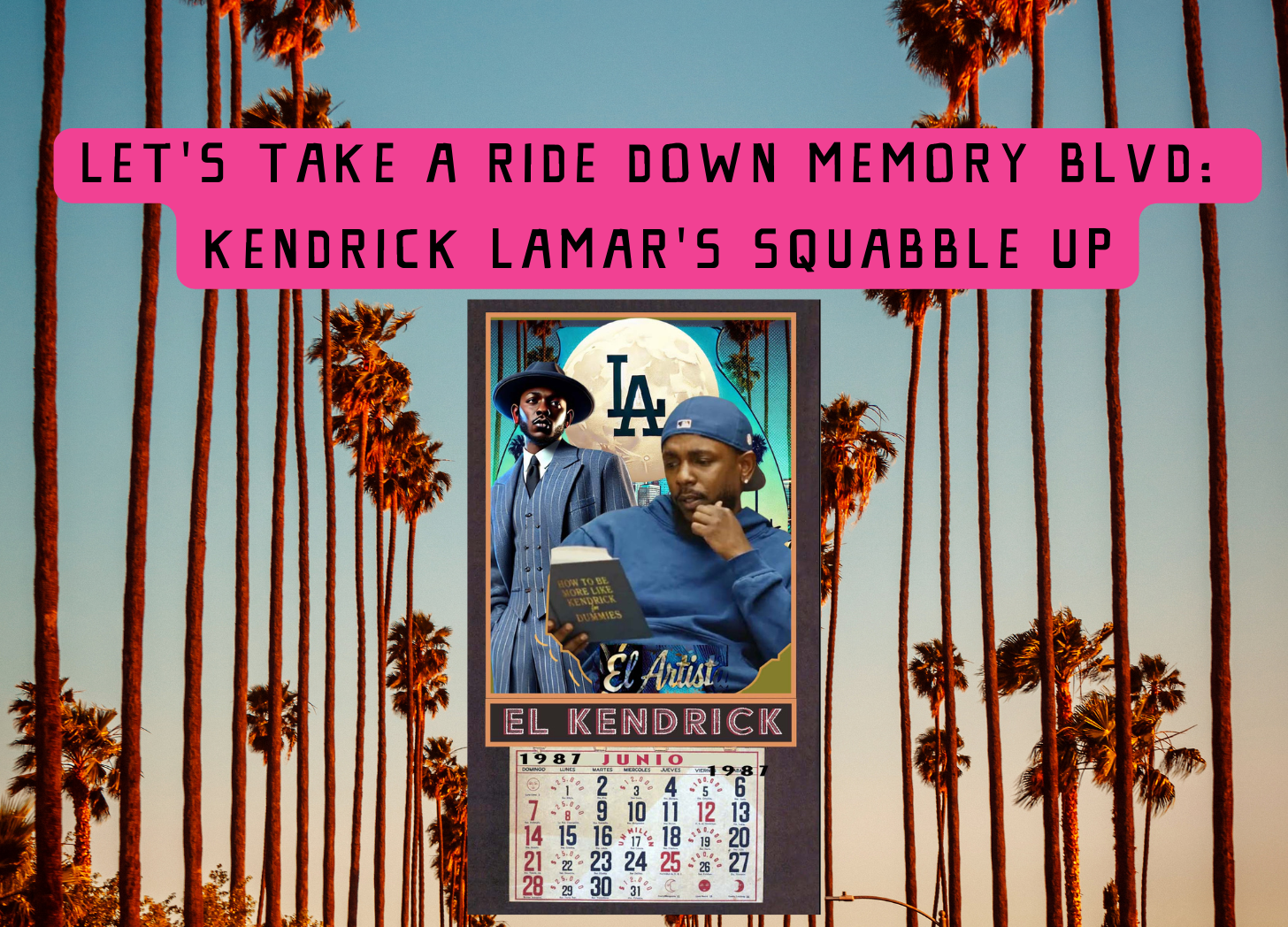
The excitement I felt when I heard the Debbie Deb sample on Kendrick Lamar’s Squabble Up off his new GNX project was overwhelming. It took me right back to being 12 and starting to navigate the treacherous teenage years with the help of music. The first record I remember buying was Fascinated by Company B. I listened to that song over and over and over again. This style of music that was called Freestyle was extremely popular and overlapped with a lot of early hip-hop in those days in California. According to Wikipedia, freestyle music developed in the early 1980s in New York:
I remember my first after school dance in the school gym at Raney Junior High in Corona in 1985. I walked into the school gym and the song “La Dream Team Is In The House” was playing and at that moment the most popular, pretty, and feared girl in school walked in with a level of confidence that I will never forget. She wore thick black eyeliner and a long flowy skirt and tank top. Her bangs were hair sprayed high and the sides of her hair were teased to look like wings, also shellacked with aqua-net. She was walking into the dance while that song was playing and she sang along to the chorus but changed the words to hype herself. “oh yes we’re here, the dream team is here” became “oh yes I’m here, Alice is here.”
Other notable songs that I loved from that genre and time that really exemplified the era include the following, and in certain neighborhood swap meets or backyard parties all across the Southland, these songs still get regular rotation:
I created the main collage art and included it as a free hi-res digital download where you can access it here. (Copyright Sylvia Marina Martinez, 2024. Not for resale, personal use only). If you would like to make a donation to support my work including all my free content on my two main blogs, I very much appreciate it.
I’ve always thought of rap as a form of folk music or street journalism such that it is a localized art form that springs forth from a specific community to define a specific time and place and the lyricist, a poetic scribe, shares their personal truth as well as describing the communities and lived realities of the communities they come from. Those who speak truth from the heart will inevitably resonate beyond the neighborhoods they represent. Hip-hop has given a voice to folks whose stories have often fallen between the cracks of the mainstream narratives in the media landscape. Rapper/producer/sound designer Bazille of the Cheyenne River Lakota and Crow Creek Dakota tribes is a multi-talented artist who has a gift for narrating his experience in illustrative detail, as an songwriter, lyricist and a producer. Bazille takes his listeners on a sonic trip to see through his eyes his current and ancestral homeland which is the area known as the United States. No culture or community is a monolith and thus as with other subcultures in America, there is no one Native American experience or story, but as many stories as there are people, and all of those stories deserve to be heard.
Earlier this year, I made a video edit and blog post about mural graffiti artist and community organizer, Derek “Focus” Smith. In the course of compiling that video, I asked Focus for an artist who he might want to feature in the background music of the video. He recommended Bazille so I reached out to him and let him know what I was working on and he generously sent me files and files of instrumental tracks to choose from. As I started listening to Bazille’s many many tracks and following him on social media, I was overwhelmed by his prolific talent. I highly recommend listening to all his music.
I’ve been streaming his album, WCWW (Wakinyan Cante Waokiya Wicasa) on repeat. He creates a distinct atmosphere and feeling with each track such that each song stands on its own, yet as an album it is a cohesive story. He is steadily and continuously putting out his own music and producing music for other artists as well as creating soundscapes for various plays and art exhibitions. Since I did the interview with him back in July, he’s already released his younger brother’s posthumous album, Akoyeh as well as this Sound Art Album as part of an exhibition honoring Dakota Artist and Cultural Icon Oscar Howe.
Though he had no access to musical education or instruments growing up very poor in a rural town far from any city, he did grow up in the internet era and was able to get free versions of all kinds of musical production software. We spoke about how he got started in music and the artists and albums who inspired him to rap, especially Maniac (the Siouxpernatural) and Derelict.
Maniac lived on the same reservation and gave him his first mic. Bazille still lists Maniac’s album“Nightmerika” as one of his favorite albums.
“Maniac’s (music) sounded like Eagle Butte and a particularly dark time and side of Eagle Butte. There’s always something you hear in the vibe and energy that is specific to that location.”
Music can be so many things to humans because it’s so powerful it can be a mirror to help us give voice to emotions we previously couldn’t put words to or it helps us dream of possibilities beyond our current circumstances. For young teens, but I think for a person of any age, hearing music that resonates with your own experience or speaks to a particular time and place can really help a person feel seen and heard.
Bazille’s music is also a vehicle for community empowerment and education in that he shares a lot of knowledge and experience in his songs but also through his work at the Wonahun Was’te’ Studios, As part of a community arts center, anyone can have access to the studio label’s network, entry-level equipment and software, tutorials, guidance on using software and equipment, and support through the production and release process. Through his assistance, Bazille is able to give kids today access that he didn’t have growing up.
In terms of producing and collaborating with other artists, Bazille said
“My thing is conceptualizing and obsessing over themes and storytelling. So finding a way to naturally [add my contribution] like whatever songs we’re creating out of our time together, whether it’s online or in person. I think that’d be disrespectful to not put forth full energy and effort. I make sure that my 50% is [solid] It’s like, it comes together in a way that, like my input can be okay, here’s how it’s structured. Or here’s a couple of beats from me, or a couple of features from people that I know, that maybe you haven’t worked with yet. And vice versa.”
Regarding him speaking out on topics that he feels strongly about.
“I overheard an interview with a rap artist who was a freestyler. And he was really good at it. And he was saying, if you don’t have anything to say, then rap isn’t for you. And I was like Whoa, taken aback by that, like what does he mean? And so then moving forward, I became obsessed with that. So certain things I would listen to would either be because of that meaning or there’s also a production side of me that really appreciates the storytelling of sound, particularly King Crimson’s first album, the court of the Crimson King. It’s so well composed and put together.”
Bazille has a series of solo singles reflecting on some salient topics both personal and political, but of course the personal is political. Bazille uses his music to show support for people in his community fighting for civil and land right issues as well as to make commentary on social issues both personal, and historical.
One of his songs that really speaks to the nuances of contemporary effects of colonization is the song Land Acknowledgement. Specifically referencing the Sturgis Motorcycle Rally, which is in earshot of the mountain where local tribes traditionally pray and meditate. Bazille puts it this way:
“Imagine, you’re in church and literally now or there’s people in the basement [being loud and disrespectful]. And you know, and you can see it all. [There is this] systematic thing that allows [kidnapping and drug] crime syndicates to thrive and so even though I’m a kind of anti-government or police type of dude, I would even say, if their job (the police) is to serve and protect, why promote the certain events and exchanges that definitely bring a rise in this activity? And then at the same time, they over-police our expression and our way of being since the moment they got over here.”
We also talked about some future projects he would like to explore in depth.
“One future project I want to do is to look at how different [indigenous] communities express hip hop, particularly in South Dakota. I’ve been in so many of them that I’d like to celebrate the history of it, but also looking at music history and American Indian relations history since the early times.”
Referencing the documentary called Rumble: The Indians Who Rocked The World, featuring rock icons like Ozzy and Slash talking about Native American contribution to modern American music.
“They basically got a lot of their stuff [archetypes/iconography] from indigenous people and characters in music history. And in many different tribes, I know this is true, but specifically in the one that I can speak for, which is my own, historically, we had people who the way that they describe it is, they would almost perform in a way that was happy and sad, made you laugh and made you cry. But that [character] also was the only thing out there that had the authority to, in a jester-like way, poke fun at leadership, question the everyday things that we just kind of follow and abide by. And I feel like in hip hop and rap, for those who are really like, passionate about the specific craft of it, they are particularly interested in doing just that. Questioning the authority, making fun of the authority, even though there’s a lot of fear in rap and hip hop. And then also making you scared, you know, with the visual, with the energy, with the sound, if you’re not ready for it, but then with that same energy almost making you proud and happy to the point where you would shed a tear. And you’ve got to wonder what it does for people to at least acknowledge the reality, good or bad, that exists there in somebody’s psyche. Because, you know, in these, if you talk to any of these artists, none of these artists is about self harm, or community self harm. I refuse to believe that I think some are oblivious to the effects that some of these things can have. But there are artists out there who kind of dance this dangerous line. And, and I feel like it’s for a really just purpose that people don’t often understand. But I think that’s part of the dance, the ancient dance of the jester, which is to be misunderstood. They say good comedy, right half of the room is laughing. Half of the room is disgusted and horrified. And I feel like in rap, that’s often the case.”
We talked about how the legendary Tupac played that role in mainstream hip hop and the significance of artists who bring their genuine, vulnerable selves to their work. Referencing DMX during Woodstock 99:
“I think of the sacrifice that DMX made as a human being, as a spirit, to bring that kind of genuine prayerful energy to any space he walks into, regardless of who’s there. And I feel like that’s a real reason why something like that is so impactful, too, because, you know, we share these things with intention, and with vulnerability and prayer. But I think what gets lost in the capturing of those moments is oftentimes, those have to be in situations in places where you are under-appreciated for doing so. [But in most of those type instances,] I feel like we as the public won’t see them. Because when they’re done out of that genuineness, you know, they’re not announced. It’s not a big deal. It’s just like, when we go on to a ceremony as Dakotas or Lakotas, a lot of my uncles will say, ‘we’re not here for a spectacle for a show.’ We’re just here to devote ourselves in prayer to say thank you, to hope that we are making ourselves strong for whatever future may come to accept good or to accept bad that comes our way and make the best of it when we can. But when we go into that space of prayer, we aren’t expecting a million light shows and God to come and say everything’s gonna be okay. It’s part of that faith is not knowing.”
We spoke a bit about his late younger brother Taran and how he (Taran) was able to take his adversity and rather than become bitter, he grew in his understanding of the universe, his spirituality and faith.
“When I came back from college I was really worried because I only visited home three times in those four years. When I come back and we’re getting older and he’s getting a job and doing this and that if he ever has any extra, he was helping people. He wasn’t announcing it to the world.”
In terms of his brother Taran’s music,
“He grew up seeing me do it my whole his whole life. So, you know, when he passed, I actually went through his files and I knew that we had recorded maybe two or three things together. .. But when I started searching back in the logs of his folder he had made like three other songs. And I never heard them before until after he passed. So that was a trip. And since then, I’ve been finishing them and and like mixing and mastering them, to put an album out for him (Akoyeh, released in July 2023). ”
Below are links to interview clips Bazille has recently posted on his instagram as well as links to the various exhibits and plays he has done the sound for. Follow Bazille on Instagram and Bandcamp to keep up with his latest creative endeavors.
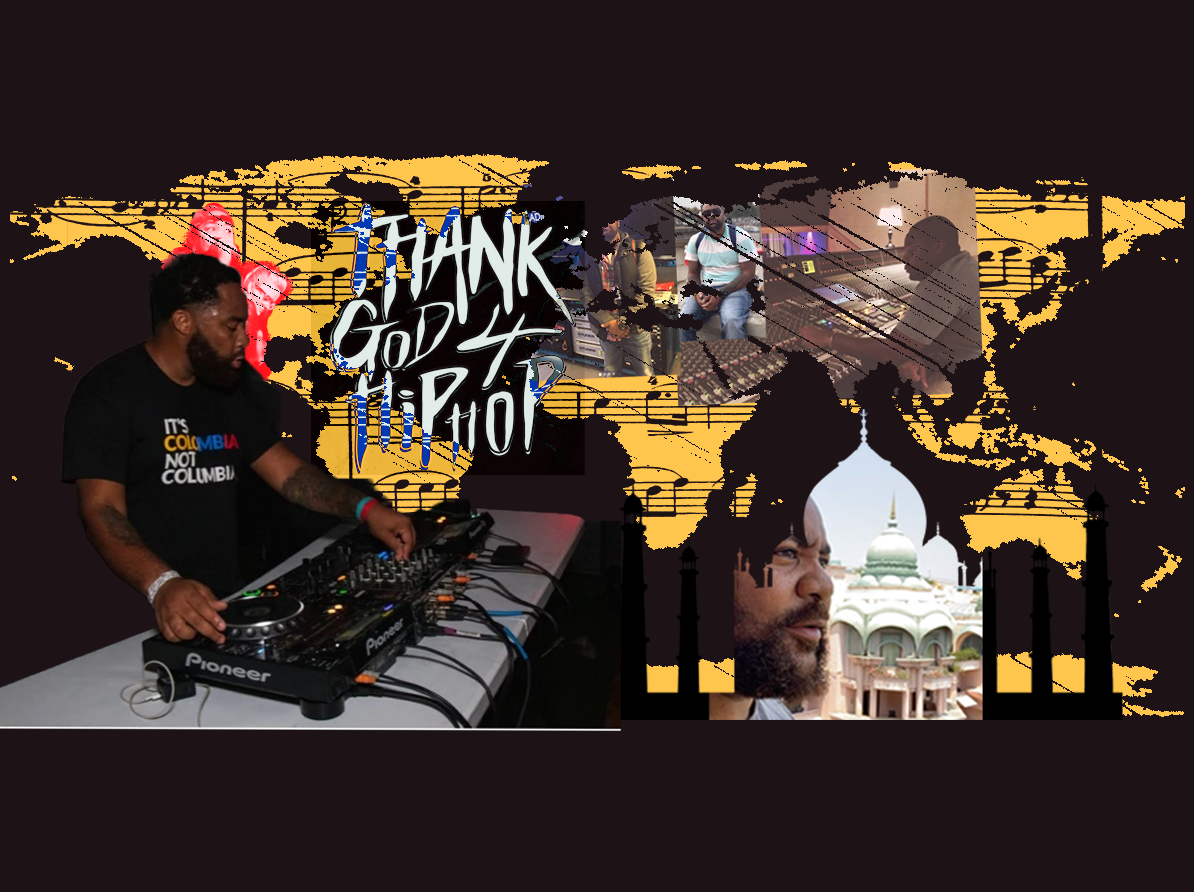
I first met Chase “Flow” Bradley at least 10 years ago when I was working at the Grammy Awards. I can’t remember the context but I do remember him being a genuine and consistently cool person as well as a multi-talented, multi-disciplinary rapper, DJ, and producer dedicated to not only his craft but also to mentoring youth to pass on what he has learned about songwriting, production, DJing and the business aspect. A true music lover, he has collaborated with artists across genres including electronic and dance. In fact, he has performed with a long time friend of mine, the beautiful and talented dance electronic artist, L. Ariel. I’ve just seen him continue to grow over the years and been really impressed with his commitment to both developing his craft and always having the community and youth in mind. Recently I saw that he had been performing all over the globe and was really excited to learn more about his experiences bridging cultures and crossing borders especially taking hip-hop from his hometown of Philly to spots as far as India, Tokyo, and the Philippines.
Here is a condensed version of some of what Chase shared with me:
What styles of music growing up sparked your love of music?
“The music that sparked me into wanting to create was by Bad Boy Records and the Wu-Tang Clan, though I grew up listening to a wide range of music from Jazz to Funk to Gospel, but ultimately it was Hip-Hop that resonated with my spirit. Two groups I recall hearing do Hip-Hop for the first time were Christian groups Transformation Crusade and my older brother’s group Infinity as well as the pioneering hip-hop band Arrested Development. They were my introduction to the game, but ultimately it was the production of RZA of the Wu-Tang Clan and the witty lyricism of the late great Notorious B.I.G. that captured my attention and made me fall in love with the culture and the art.”
Can you share some other artists who have been heros or influenced you in your work?
Can you tell me about the youth organizations and mentoring you have been involved in?
“The Chase What Matters Program (The CWM Program) is a nonprofit program I started fall of 2022 back in my hometown of Philadelphia, Pennsylvania teaching children the basics of songwriting, music production, DJing and the business of music. I first got involved with working with youth 2014 working with an organization in Anaheim, California, Rytmo (Reaching Youth Through Music Opportunities).
My vision is to expand the program globally and empower youth who aspire to become professionals in the music industry and create channels for youth worldwide to be able to connect and collaborate with each other. “
Can you share the story of how you ended up going internationally to play music and what has that experience been like? Have you found local music in the different countries that inspires you? What’s been the most surprising thing you’ve learned?
“My first time I ever traveled out the country was in high school to Quebec, Canada for a retreat with my school. But it was a trip to Hong Kong and The Philippines with my cousin in 2017 that would change my life. Ever since that trip I haven’t missed a year of traveling internationally even through Covid. Traveling for me is a huge part in my life and feeds my creative energy. I find it important to see life from other perspectives to help me broaden my view from just what I knew from growing up. As a DJ, knowing what moves people and how to blend that with stuff I know and like, shows how we are all connected in life. I’ve deejayed on cruise ships, night clubs, and bars all around the world and the power of American music continues to be impactful everywhere I go. In terms of some of my go-to international songs that really get people excited, there is Master KG-Jerusalema of South Africa, Stan Rogers – Barrett’s Privateers of Canada, Joe Arroyo- Rebelión of Colombia, just to name a few.
I recently just came back from a tour through Asia touring my latest project Thank God 4 Hip Hop and the vibes of that continent were very very inspiring for me. A standout inspiration for me was Shibuya, a region in Tokyo, Japan. As I was headed to DJ, I saw an impromptu crowd gathered in an alley having a concert. It just showed me that no matter language, color, religion, or gender music is something that connects us all as humans. One thing as a DJ no matter where I go or what crowd I play for, Michael Jackson always gets the party moving. “
Can you tell me more about your specific projects and ventures you are working on?
Thank God 4 Hip Hop is a compilation album/mixtape I put together to showcase music I had produced and wrote for different artists. This was my introduction as a host mixtape DJ by myself. Thank God 4 Hip Hop is really more than just a brand logo and music, but an homage to two important things that saved my life, God and Hip-Hop. This is just my way of saying thank you to God and the culture of Hip-Hop. There will be more projects, merch and content coming soon under the brand.”
What kind of dreams and goals do you envision?
“My dreams as a musician of course charting in the billboard hot 100, having a few number ones, platinum and Diamond records, a few Grammys, AMAs, etc as a producer, songwriter and artist. I want to help over a thousand kids worldwide, create more jobs and opportunities for people by helping guide and inspire the future musicians of the world through my program initiatives.”
Collage Art & Illustration by Sylvia Marina Martinez. All collage photos provided by Carla Macal. Gallery photos at end of article are all public domain.
Two weeks ago, I published a blog post on the mural & graffiti art and hip-hop music of Lakota artists Derek Smith and Talon Bazille, respectively. As I was writing that post I was simultaneously working on a collage art piece for my cousin’s dissertation to illustrate the concept of cuerpo territorio amongst Indigenous GuateMayan women as they create embodied public memories. I really see the work of both Focus and Bazille as part of this tapestry of claiming space and healing through expression. From Carla’s abstract: “Cuerpo territorio declares the body as our first territory” and the concept is used among healing circles of Indigenous Latin American women to also map and document the violent extraction and abuse of their homeland and/or sacred land territories. Below is Carla’s dissertation abstract and if you want to reach out to her about her work you can reach her by clicking on this link.
Cuerpo-Territorio: Embodied Transformative Memory and Cartographies of Healing among GuateMaya Feminist Groups:
“My dissertation closely presents the case studies of two GuateMaya feminist groups that are challenging state-dominant narratives of the Guatemalan 36-year- war (1960-1996) and foregrounding counter-narratives with art, Maya cosmovision spirituality, and gendered embodied memory production. The groups are also denouncing contemporary feminicide cases through the cosmo-political praxis of cuerpo-territorio. Cuerpo-territorio declares the body as our first territory and advocates for a communal subject agency. I develop this deeply embodied framework to examine how 8 Tijax and GuateMaya Mujeres enResistencia-Los Angeles (GMR-LA) are challenging the state’s hegemonic memory by actively engaging in embodied transformative memory experiences, or what I describe as healing cartographies. I assert that such healing cartographies at the scale of the intimate contribute to hemispheric decolonial solidarity. These healing cartographies contradict and actively challenge the Guatemalan state’s claims of what can be remembered or erased when the evidence is embodied and reiterated, told through stories, and brought into being by active remembrance. I use a community-based participatory approach and feminist ethnographic methods to both examine and support the transnational affective solidarity connecting GuateMaya women throughout the hemisphere. My dissertation is a political project of unearthing the counter memory, silences, fear, and intergenerational trauma from the oral and embodied testimonios of GuateMaya women survivors of genocide who are currently involved in collective projects to recover Guatemala’s historical memory. While GuateMaya feminist groups are connected across the United States, Mexico, and Canada, the focus of my study is on the relational testimonios of GuateMaya feminist groups in Guatemala and Los Angeles.
Carla described her vision of what she was envisioning to illustrate her five years of fieldwork doing workshops in Guatemala and in Los Angeles. She wanted to use the body as a map showcasing the maps of healing as seen through written testimonies of survivors, photos of workshops, the body maps drawn by the survivors in the workshops, the altars and other elements of Mayan spiritual practices, photos of street art and public memorials, and memorial tattoos. I drew the outline of a woman and scanned into photoshop and then combined in layers the photos that Carla provided from her dissertation as well as a map showing the route from Guatemala to Los Angeles. Carla told me that the red carnation symbolized historic memory so I created a flower frame using digital cutouts of photos of carnations. I posted below the video Carla made describing the workshops as well as two Mayan musicians who are singing about the genocide and ancestral memories. It strikes me that the music and poetry also weave collective memories and healing solidarity in space and time to enrich the rich texture of these healing maps. This is all making sure history is told from the perspective of those whose voices would have been attempted to silence for eternity. The myth of Indigenous invisibility should continue to be challenged.
The power and strength of Indigenous folks to resist, survive and thrive from the Northern edge of North America to the Southern tip of South America under the force of extreme oppression cannot be overstated. I feel it my humble duty to use whatever platforms and talents I’ve been given to amplify the stories and voices of those who have been attempted to be silenced for far too long. May we all recognize our interconnectedness and understand that no one is free until we are all free.
Video about Carla’s dissertation.
GuateMayan musician Aurora Nohemi sings about women uniting and culture.
GuateMayan Rebeca Lane – La Cumbia de la Memoria sings about the reality of genocide
Resources and articles below so anyone may educate themselves on the realities of Indigenous Guatemala.
Lakota graffiti artist, muralist and community organizer Derek “Focus” Smith has been challenging the power structure of the “Mississippi of the North” since the early 2000s bringing the power of graffiti and muralism to the Reservation and using his craft to tell the stories of Lakota history and encourage the youth. The art has taken him around the world. I first ran across Focus’ work during the uprisings after the death of George Floyd on Instagram and saw he had contributed a mural in the George Floyd Memorial. As a collage artist, I’m extremely influenced by all forms of political and cultural street art so Focus’ story was extremely compelling and the more I learned the more inspiration I drew from his work. This video below I made using the footage from the talk he gave to the Racing Magpie organization in South Dakota.
The music I used in the video is all by Talon Bazille, a rap artist, producer and sound designer from the Cheyenne River Lakota and Crow Creek Dakota tribes in South Dakota. As a college student at the University of Pennsylvania, Bazille hosted a weekly radio show in an effort to promote underground hip hop artists. As a result, he took the plunge back into creating his own music, which he had begun recording at age 13, under the wing of supportive uncles in South Dakota, producing beats and learning how to engineer audio in the process. Upon graduating with a bachelor’s degree in psychology, Bazille released what he considers his “personal thesis” project: “Sake” (Talon in Dakota), a 51-track self-produced solo album.Today, Bazille lives in South Dakota where he continues to create music, produce other artists, and compose soundscapes. His work has been performed in places like the Kennedy Center all the way to small tribal halls back on the reservation. Here is his latest video:
As hip hop culture celebrates 50 years, its reach and influence has encouraged legions of youth from around the globe to give voice to their struggles to tell their stories through the rhymes, beats, and words both creating a visual and sonic movement. The attempt to erase Indigenous history and culture is well-known in the abusive paradigm of settler colonialism that is still attempting to silence and erase the reality of the brutality and hide the hypocrisy in the American story. I see hip hop music (and culture) as the ultimate roots music that has emerged as a form of street journalism narrating the stories of the voiceless. As long as humans have existed, folks have expressed resistance and resilience to oppression through art and music. As many who are paying attention to the current politics the authoritarian extremists are fighting hard to hold onto the last vestiges of a crumbling empire. Any of us alive today regardless of where we live need to realize that “none of us are free until all of us are free.” So many indigenous artists and activists are making their voice heard as poet Joy Harjo writes: “We are still America. We know the rumors of our demise. We spit them out. They die soon.”
“The hope of a secure and livable world lies with disciplined nonconformists who are dedicated to justice, peace and brotherhood.” ~ MLK, Jr.
The year 2014 is upon us and as we come to terms with tragic consequences of global apathy, the creative mind and spirit of the earth and universe instills in us the will to live.
As the late great troubadour Pete Seeger, who passed away this week, said: “The key to the future of the world, is finding the optimistic stories and letting them be known.” May his spirit and legacy live through us. We lost another world legend this past year as well in Nelson Mandela. Both men that lived long and inspired lives fighting in their own way for justice, equality, and community. Let us move forth with the spirit of both.
Pharrell Williams needs no introduction. He’s a producer, songwriter, activist, filmmaker, interviewer, etc. His creative spirit knows no boundaries, so we will do well to listen to his words. “I just appreciate where music is right now…so many original artists…musicianship is now going to be back at all time high”:
Recently I watched the movie Antonia, a movie about a female hip-hop group from São Paulo. It has a gritty, authentic feel (and features real-life Brazilian rap artists), made by the same filmmakers who did the heartbreaking City of God. A few years after City of God, an inspiring documentary came out called Favela Rising, about a former gang member turned revolutionary using music to keep kids away from the violent streets. This movie shows the important interweaving of music and culture and what it means for kids growing up in less than ideal circumstances. Music becomes a voice for the voiceless.
It got me thinking about the hip-hop I grew up listening to in the late 80s through early 2000s. Granted there was plenty of party-oriented songs about dancing and having fun, but there were also many top hits about the rage, the despair, and the true grit it took to rise up from some of the most violent neighborhoods in America. The world was listening and the art form exploded. With the success of rap in Africa, the Middle East, Asia, and Latin America, hip-hop is a way for youth who are struggling to make it out of violence and poverty to tell their stories and express their realities. According to Wikipedia page on hip-hop in Brazil:
Brazilian hip hop has its origins in the favela street parties of the 1980s where American funk and hip hop was played. By the early 1980s the nascent Brazilian hip hop movement was centered around the city of São Paulo especially São Bento Square, 24 de Maio Street and the Teatro municipal where break dancers and rappers congregated to exchange ideas and information. Racionais MC’s (Mano Brown, Ice Blue, Edy Rock and DJ KL Jay) from São Paulo were amongst the earliest Brazilian hip hop groups to make an impact with their music which criticized the city’s unequal wealth distribution, the lack of opportunity given to children growing up in the favelas, São Paulo’s state government as well as promoting an anti-drugs agenda…Brazilian rap has served as a reflection of the political, social and racial issues affecting the disenfranchised youth in the suburbs of São Paulo and Rio de Janeiro. The lyrical content, band names and song names used by Brazilian hip hop artists are often related to the socio-political issues affecting their communities.
Regarding music with the themes of social justice, narratives about street life and the like, unless it sounds good and the rhyming is right, it really doesn’t have an impact. I’ve found three hip-hop artists below who are considered a few of the forefathers of hip-hop Brasiliero. The music and lyrical delivery is simply on point.
Racionais MCs are a group that are considered one of the originators of the form in Brazil. Here they are live with what sounds like an anthem, “Eu Sou 157”: