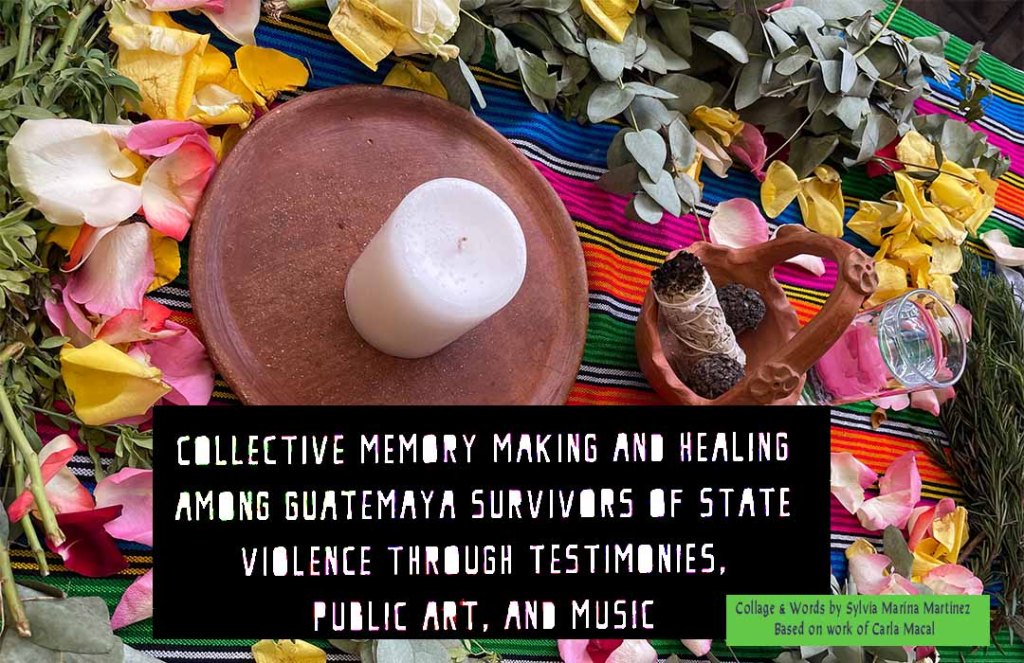
Collage Art & Illustration by Sylvia Marina Martinez. All collage photos provided by Carla Macal. Gallery photos at end of article are all public domain.
Two weeks ago, I published a blog post on the mural & graffiti art and hip-hop music of Lakota artists Derek Smith and Talon Bazille, respectively. As I was writing that post I was simultaneously working on a collage art piece for my cousin’s dissertation to illustrate the concept of cuerpo territorio amongst Indigenous GuateMayan women as they create embodied public memories. I really see the work of both Focus and Bazille as part of this tapestry of claiming space and healing through expression. From Carla’s abstract: “Cuerpo territorio declares the body as our first territory” and the concept is used among healing circles of Indigenous Latin American women to also map and document the violent extraction and abuse of their homeland and/or sacred land territories. Below is Carla’s dissertation abstract and if you want to reach out to her about her work you can reach her by clicking on this link.
Cuerpo-Territorio: Embodied Transformative Memory and Cartographies of Healing among GuateMaya Feminist Groups: “My dissertation closely presents the case studies of two GuateMaya feminist groups that are challenging state-dominant narratives of the Guatemalan 36-year- war (1960-1996) and foregrounding counter-narratives with art, Maya cosmovision spirituality, and gendered embodied memory production. The groups are also denouncing contemporary feminicide cases through the cosmo-political praxis of cuerpo-territorio. Cuerpo-territorio declares the body as our first territory and advocates for a communal subject agency. I develop this deeply embodied framework to examine how 8 Tijax and GuateMaya Mujeres enResistencia-Los Angeles (GMR-LA) are challenging the state’s hegemonic memory by actively engaging in embodied transformative memory experiences, or what I describe as healing cartographies. I assert that such healing cartographies at the scale of the intimate contribute to hemispheric decolonial solidarity. These healing cartographies contradict and actively challenge the Guatemalan state’s claims of what can be remembered or erased when the evidence is embodied and reiterated, told through stories, and brought into being by active remembrance. I use a community-based participatory approach and feminist ethnographic methods to both examine and support the transnational affective solidarity connecting GuateMaya women throughout the hemisphere. My dissertation is a political project of unearthing the counter memory, silences, fear, and intergenerational trauma from the oral and embodied testimonios of GuateMaya women survivors of genocide who are currently involved in collective projects to recover Guatemala’s historical memory. While GuateMaya feminist groups are connected across the United States, Mexico, and Canada, the focus of my study is on the relational testimonios of GuateMaya feminist groups in Guatemala and Los Angeles.
Carla described her vision of what she was envisioning to illustrate her five years of fieldwork doing workshops in Guatemala and in Los Angeles. She wanted to use the body as a map showcasing the maps of healing as seen through written testimonies of survivors, photos of workshops, the body maps drawn by the survivors in the workshops, the altars and other elements of Mayan spiritual practices, photos of street art and public memorials, and memorial tattoos. I drew the outline of a woman and scanned into photoshop and then combined in layers the photos that Carla provided from her dissertation as well as a map showing the route from Guatemala to Los Angeles. Carla told me that the red carnation symbolized historic memory so I created a flower frame using digital cutouts of photos of carnations. I posted below the video Carla made describing the workshops as well as two Mayan musicians who are singing about the genocide and ancestral memories. It strikes me that the music and poetry also weave collective memories and healing solidarity in space and time to enrich the rich texture of these healing maps. This is all making sure history is told from the perspective of those whose voices would have been attempted to silence for eternity. The myth of Indigenous invisibility should continue to be challenged.
The power and strength of Indigenous folks to resist, survive and thrive from the Northern edge of North America to the Southern tip of South America under the force of extreme oppression cannot be overstated. I feel it my humble duty to use whatever platforms and talents I’ve been given to amplify the stories and voices of those who have been attempted to be silenced for far too long. May we all recognize our interconnectedness and understand that no one is free until we are all free.
Resources and articles below so anyone may educate themselves on the realities of Indigenous Guatemala.
CURRENT INDIGENOUS VISIBILITY & RESISTANCE
- Maya Language Hip Hop, Cultural Resilience, and Youth Education in Guatemala
- Indigenous Erasure and the Fight for Recognition
- Out of the Shadows: The Communities of Population in Resistance in Guatemala
- Extractive Industries in Guatemala Historic Maya Resistance Movements
- Guatemala Cracks Down on Q’eqchi’ Resistance in El Estor
- Repression, Resistance, and Indigenous Rights in Guatemala
- Indigenous Language Migration Along the US Southwestern Border—the View from Arizona
- UCLA project maps LA’s indigenous communities
- Legacies of conflict and natural resource resistance in Guatemala
- Civil resistance in Guatemala
- Le Maya Q’Atzij – Our Maya World: Poetics of Resistance in Guatemala
HISTORY & DOCUMENTATION OF GUATEMALAN GENOCIDE
- GENOCIDE OF MAYAN IXIL COMMUNITY
- Genocide and Resistance in Guatemala
- U.S. Role in Guatemalan Abuses
- U.S. Militarization of Guatemala from the Internal Armed Conflict to the Present
- Genocide in Guatemala
- How the Guatemalan civil war became a genocide: Revisiting the 2013 trial of General Efraín Ríos Montt
- The Guatemala Genocide Ruling, Five Years Later
- Guatemala to search for bodies of Indigenous children believed killed in civil war massacre
- Violence and Genocide in Guatemala
CUERPO TERRITORIO
- Embodied Geographies: Feminist Body-Mapping with Amazonian Indigenous Girls, Cuerpo-Territorio, and the Outlining of a New Academic Grammar
- AMNESTY – Vivan Las Mujeres
- Guía Mapeando el Cuerpo-Territorio
- Cuerpo-Territorio: A Decolonial Feminist Geographical Method for the Study of Embodiment


