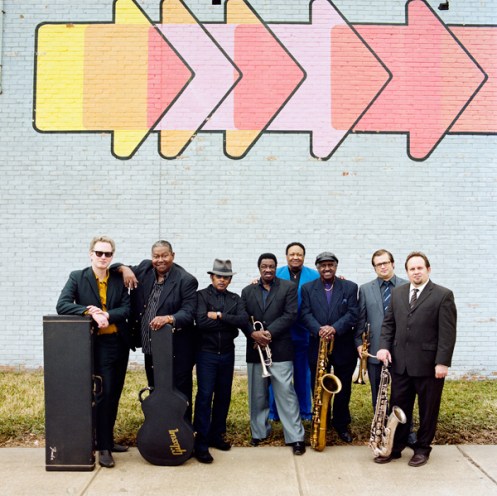
Scott Bomar, the musical mind behind the award-winning soundtrack of Hustle & Flow AND the producer of the band, The City Champs, has a really cool project going on in the style of Booker T & The MGs, called The Bo-Keys.
I love this short 12 minute documentary about the background of these guys – some serious history between them all! They’ve played with major soul and blues greats including Isaac Hayes, Bobby “Blue” Bland and others. I heard they’ll be playing the Ponderosa Stomp in New Orleans in September. Should be a good time!
Wow, hello there! Sheesh – been awhile! I’ve been a hiatus for the past few months, but hopefully I’m back for good. I’ve been recuperating from a surgery so spending a lot of time plugged into what is going on in the world (prayers to Japan and the Mid-East/North Africa most definitely) and also pop culture (American Idol – Casey Abrams please!). Couldn’t do much else than just sort of watch the world from a distance, but finally I’ve felt my energy levels return and I thought I’d get back to doing some blogging about music.
Let me get right to some great roots music from East Africa – Ethiopia to be exact. Mulatu Astatke is an Ethiopian jazz musician who studied all over the world including Berklee School of Music in Boston. He merged his love of jazz, especially Latin jazz, with his own cultural traditional sounds creating a distinct genre of music called “Ethio-jazz”. He released an album last year, “Mulatu Steps Ahead” his first solo project in decades with some top jazz musicians helping him out. Most of his music is instrumental, making it a favorite of 70s vinyl funk/jazz collectors and artists like Nas, Damian Marley, Cut Chemist and Knaan, who have sampled many of his songs in their own music. Here is a smattering of songs I found scouring youtube for your listening pleasure and to get a taste of his flavor.
Thanks for reading and I’m so grateful for each and every person who visits this blog. I’m shocked that after months not posting, my older posts continue to get a steady stream of music loving visitors every day! I hope to find my groove again in 2011. Peace, love and soul to you all!
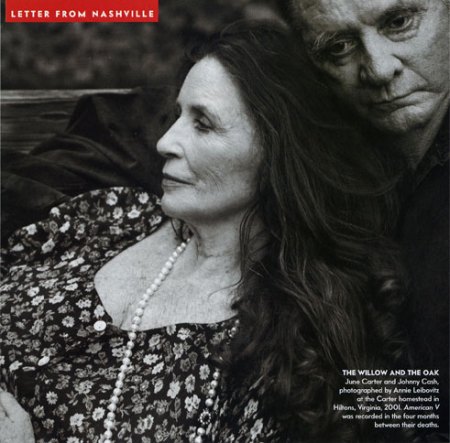
Well call me corny, but I get weepy for a beautiful love story. And inspired. One of my favorite girls Steph is getting married in 10 days to her dream man and to celebrate we had a karaoke night out. I felt creative and inspired so I baked lemon cupcakes for the occasion and sang my favorite love song dedicated to them, “If I Were A Carpenter” originally by Bobby Darin but of course famously covered by June and Johnny Cash. Jim and Steph also sang a Carter duet, “Jackson”. A fun night was had by all and everyone in the bar was feeling the love! Here’s to you Steph and Jim – and to all those couples out there who found their partner in crime (metaphorically speaking that is). Blessings for a long life filled with love, peace, and strength through all the inevitable twists and turns that this amazing life brings.
Here they are with “Jackson”:
This is really cute – “Where Did We Go Right” from a performance on Austin City Limits:
I just discovered this song by Vermont folk singer Anais Mitchell and Bon Iver’s Justin Vernon. “Wedding Song” – hauntingly beautiful:
A traditional Sephardic wedding song sung by Francoise Atlan during the Festival of Sacred world music in Morocco, “Scalerica D’oro” or “Stairway of Gold” in the Ladino (a mixture of Spanish and Hebrew or Judaeo-Spanish) language:
Since September is traditionally back-to-school month, I thought I’d do a short history lesson on some of the most influential roots piano players. Whether barrelhouse, boogie woogie, boogaloo, or rumba, hard pounding rhythmic piano playing has found its home in the brothels and the concert halls, with styles traveling that swath of land and sea from the Caribbean up through the blues highway to Chicago.
Let’s start our journey at the barrellhouse, defined as both a 1) disreputable old-time saloon or bawdyhouse and 2) an early style of jazz characterized by boisterous piano playing, free group improvisation, and an accented two-beat rhythm.
Champion Jack Dupree was the epitome of New Orleans boogie woogie and barrelhouse blues piano. His birthdate disputed, but the year was between 1908 and 1910. He lived a long life, passing in 1992.
James Edward “Jimmy” Yancey was born in Chicago in 1898 and was a famous pianist by 1915 influencing the boogie woogie style of Meade Lux Lewis and Albert Ammon, who were the predecessors of many blues pianists. Despite his musical prowess, he kept his job as a groundskeeper for the Chicago White Sox his entire life.
We all know that New Orleans has birthed some of the greatest jazz and blues piano players including Professor Longhair, Allen Toussaint, Fats Domino, Dr. John, Harry Connick, Jr. and Henry Butler. Less well known outside of the Crescent City is one who left all those guys in awe, James Booker, who is widely regarded as one of the greatest geniuses of New Orleans piano. Often people unfamiliar with his playing will mistake his sound as two simultaneous piano players:
Up to Chicago by way of Mississippi, Otis Spann was a blues piano player most notably with Muddy Waters, but an artist in his own right. Here he is with “Jangleboogie:”
Born in Havana, Cuba in 1913 and considered “one of the greatest pianists in the history of Cuban music, Pedro “Peruchin” Justiz made his name in Havana’s descarga (jam session) craze of the ’50s; along with Ruben Gonzalez, Lili Martinez, and Bebo Valdes, he was instrumental in shifting the piano into a much more rhythmic role in Afro-Cuban music (source)”. Here is “Peruchin”:
Puerto Rican pianist Noro Morales, born in 1912, was an innovator of combining rhythm and melody, rising to the top of the mambo and rumba word. He played with some of the mambo and salsa greats including Tito Rodríguez, José Luis Moneró, Chano Pozo, Willie Rosario and Tito Puente.
I couldn’t leave out Nuyorican Charlie Palmieri. Less well known than his brother Eddie Palmieri, Charlie gave us really solid boogaloo from the 60s to the 70s. He played with Mongo Santamaria among others. If you have the chance to pick up his album, Either You Have It Or You Don’t, do it!
I would be remiss if I didn’t mention country great Floyd Cramer, who did his own rolling country style piano playing, supporting everyone from Patsy Cline, Chet Atkins to Elvis Presley. Here he is with Chet Atkins:
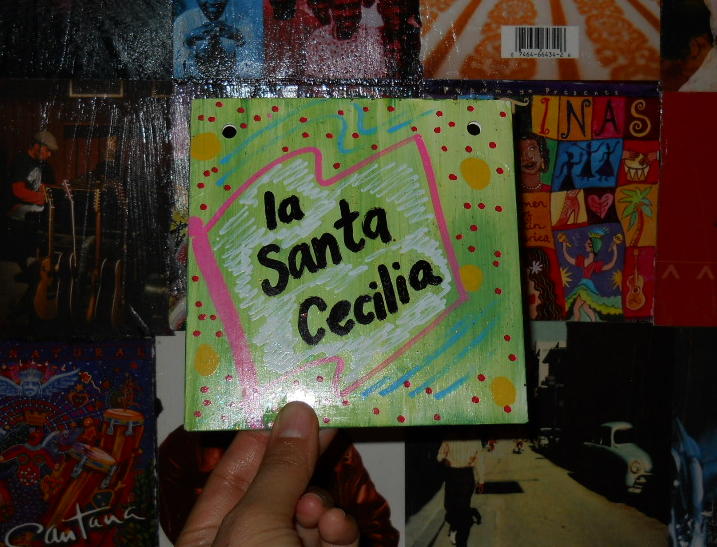
I am in love with the Los Angeles band, La Santa Cecilia, named after the patron saint of music. They play an eclectic fusion of everything soulful – from boleros to rancheros, cumbias to klezmer, folk and jazz/jam to their own unique take on the Beatles. Lead singer La Marisoul is absolutely adorable and on stage is simply fierce – simmering with sultry vocals. Guitar player Gloria Estrada is a complete bad-ass; laid back as cool as any blues cat out there. The guys in the band, all 100% on point: percussionist Miguel Ramirez, drummer Hugo Vargas, Alex Bendana on upright bass, and Jose Carlos on Requinto and accordion. This band is tight – solid and all smooth as can be, each member with their own unique style and coolness.
They are coming up strong this year with songs appearing on shows including Weeds and Entourage, playing SXSW, the Hollywood Bowl, and the GRAMMY block party. They are generating quite a buzz, with veterans of the music biz being blown away by their sound. La Santa Cecilia…I guarantee we will be hearing a lot more of them and thank goodness for that because they are the real deal.
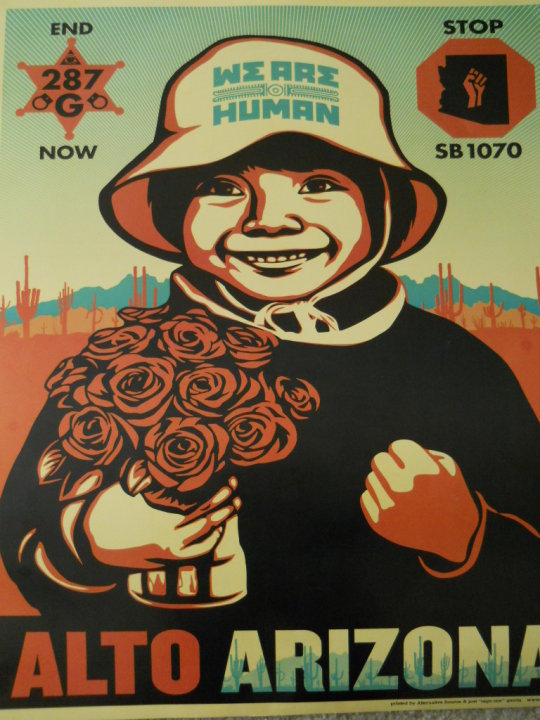
With all the insane anti-immigrant sentiment going on around the country and most notoriously in Arizona, it got me thinking of Woody Guthrie’s timeless folk song, “This Land Is Your Land.” Over the years, so many diverse musicians have done their own take. I’ve always loved Mexican-American singer Lila Downs’ version, speaking for the voiceless migrant laborers in “Pastures of Plenty”:
Recently I was watching the movie, Up In The Air. The opening song was the coolest, most soulful version I’ve ever heard by Sharon Jones and the Dap Kings:
Johnny Cash’s Version:
Los Lobos with the Grateful Dead:
Pete Seeger and Bruce Springsteen’s version during Obama’s pre-inauguration concert:
Chicago folkloric group Sones De Mexico “Esta Tierra Es Tuya”:
And the original:
This land is your land, this land is my land
From California to the New York Island
From the Redwood Forest to the Gulf Stream waters
This land was made for you and me.
As I went walking that ribbon of highway
I saw above me that endless skyway
I saw below me that golden valley
This land was made for you and me.
I roamed and I rambled and I followed my footsteps
To the sparkling sands of her diamond deserts
While all around me a voice was sounding
This land was made for you and me.
When the sun came shining, and I was strolling
And the wheat fields waving and the dust clouds rolling
A voice was chanting, As the fog was lifting,
This land was made for you and me.
This land is your land, this land is my land
From California to the New York Island
From the Redwood Forest to the Gulf Stream waters
This land was made for you and me.
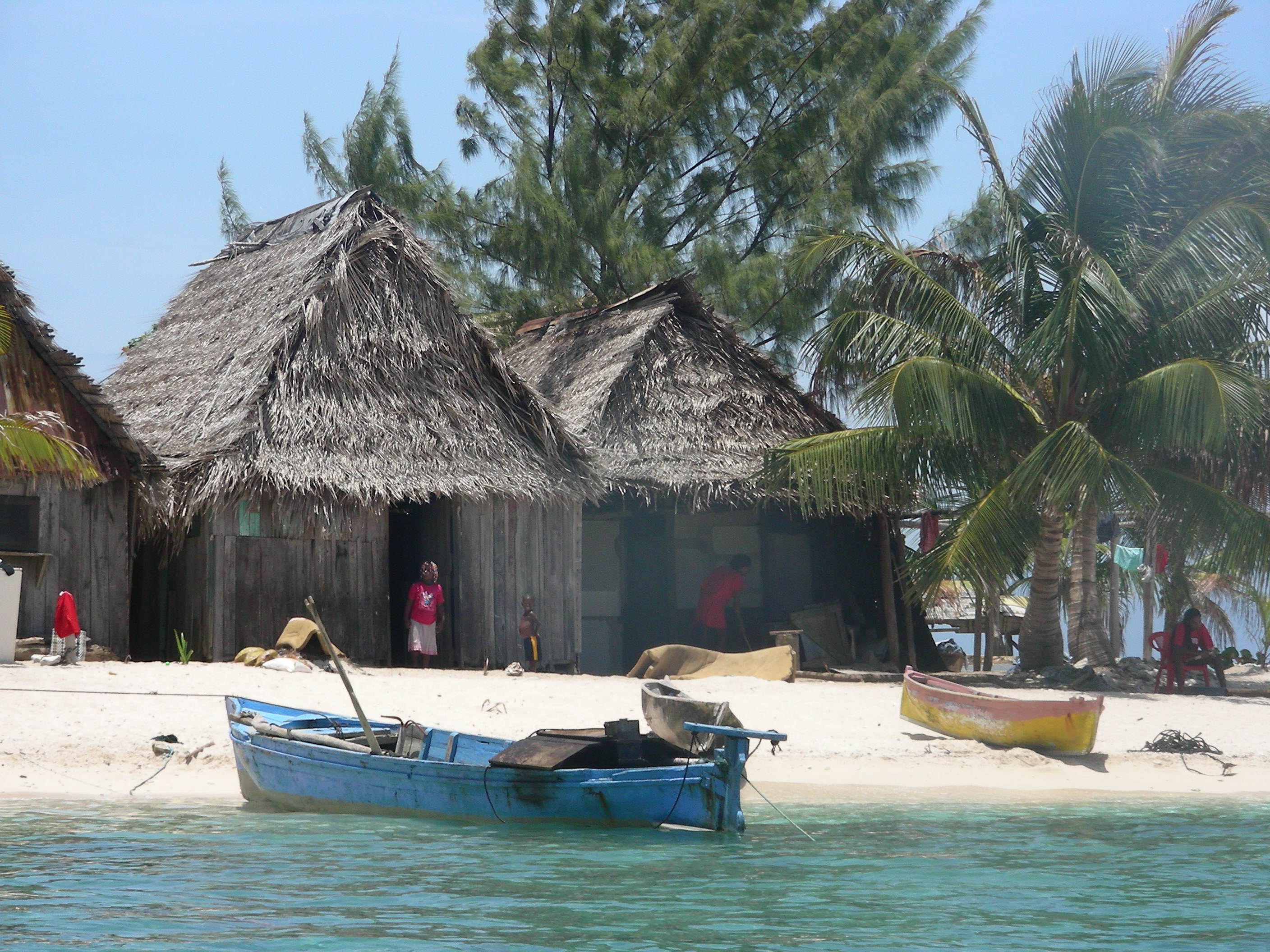
I have been following this 2010 World Cup like millions of other futbol fans from around the globe and I was so proud that my dad’s country of Honduras made it this year! It got me thinking about the cultural treasures unique to Honduras. My father was born on the Caribbean coast in La Ceiba, Honduras. Growing up he spoke Garífuna as well as Spanish with the other children, but later he forgot the Garífuna. In 2001, the language, dance and music of the Garífuna people were proclaimed by the United Nation’s UNESCO as a Masterpiece of the Oral and Intangible Heritage of Humanity.
The Garífuna people are of mixed African and Native American (Arawak and Carib) ancestry and native to the Caribbean Coast in Central America – specifically Belize, Guatemala, Nicaragua and Honduras. They have a very distinct and unique cultural heritage, language, and music and have been able to preserve that culture for many centuries.
Garífuna music has its traditional forms as well as more modern fusion forms including “Garífuna soul.” Andy Palacio of Belize, who released a gorgeous album in 2007, Watina, and tragically died shortly thereafter, was one of the most well-known preservers and teachers of the Garífuna culture. Here is Palacio’s “Watina,” the title track from the album:
And a video describing the making of the album with the Garífuna collective:
Aurelio Martinez, another popular Garífuna artist:
Traditional songs of Garífuna women:
Punta is one of the Garifuna styles of music and dance derived from folkloric traditional origins to become much more popularized throughout Central America today especially Honduras:
Folkloric Punta dancing:
Honduras – it was told to me that the name of the country came from the Spanish word “hondura” meaning depths or profundity. When Christopher Columbus left Honduras, he was rumored to have said, ‘Gracias a Dios, escapamos esas profundas honduras’ or ‘Thank God we escaped these depths.’ I thought it was in reference to the treacherous mountain ranges, but I also read it was in reference to the deep waters off the Northern coast. Honduras is a country that holds for me many mysteries, pieces of puzzles not yet solved that may remain in the realm of the unknown. I’ll be rooting for them on Friday as they play Switzerland – what an awesome thing it will be if they advance to the finals!! QUE VIVA LOS CATRACHOS!!!!!!!!!









 ROOTNOTEMUSIC BLOG